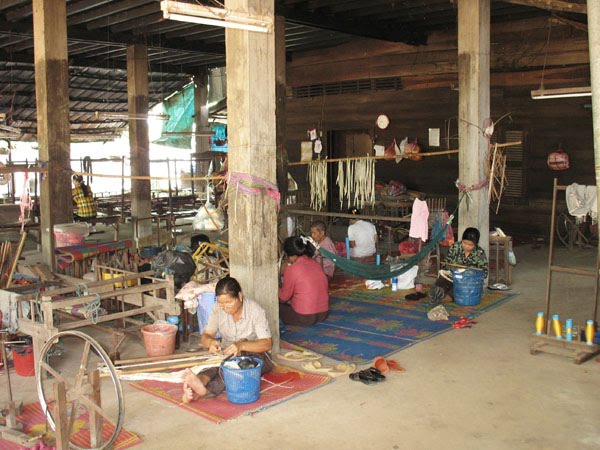
Isaan Silk... Upcountry!
What a surprise! On our recent getaway upcountry (southeast of Chiang Rai) we were taken to a weaving group- "little old ladies who raise silkworms" we were told. As we entered, past a few half-hearted displays of cloth for sale, there was a lady working at a loom; she was weaving 'mutmee'/ikat silk! This is not at all what I expected: I thought that since we were in Tai Lue country these ladies would be Tai Lue. But the patterning on the silk on the loom was clearly not Tai Lue. I asked the lady if she were from Isaan and she grinned and said "Khon Kaen". Then she volunteered that the other ladies were also from Isaan- Udon Thani and elsewhere. I assume they were around 70-80 or so years old- this was their work and their social club, allowing them to keep alive skills they learned decades ago, and to have a reason to get up in the morning. Their modest sign reads "Group Weaving Silk Cloth".


 Weaver from Khon Kaen
 Her 'mutmee' cloth on the loom. The loops of silk weft are used to adjust the pattern when weaving. They will be clipped later.
 This lady is counting and grouping the threads for later tying of the pattern, before dyeing. These are the weft threads; the warps will be of a solid color.
 In the foreground is the rack for tying the pattern onto the grouped threads; at least one dip into the dye (green) has been done, showing better the final pattern.
 This lady is cutting off the plastic bindings and will then tie on new ones to define areas to be dyed another color. It is very time-consuming work and requires practiced skills.

Below are some tied and dyed threads drying in the sun.

 These are one type of basket used for the silkworms. I want some for wall sculpture!
 Here a rack holds trays of silk worms in varying stages of growth, including the completed cocoons which will be unwound into raw silk yarns.
 Another lady shows off some baby silk worms and their meal of mulberry leaves. The ladies have several mulberry trees growing around the building. Below are more mature worms- big and fat.


 Weaver from Khon Kaen
 Her 'mutmee' cloth on the loom. The loops of silk weft are used to adjust the pattern when weaving. They will be clipped later.
 This lady is counting and grouping the threads for later tying of the pattern, before dyeing. These are the weft threads; the warps will be of a solid color.
 In the foreground is the rack for tying the pattern onto the grouped threads; at least one dip into the dye (green) has been done, showing better the final pattern.
 This lady is cutting off the plastic bindings and will then tie on new ones to define areas to be dyed another color. It is very time-consuming work and requires practiced skills.

Below are some tied and dyed threads drying in the sun.

 These are one type of basket used for the silkworms. I want some for wall sculpture!
 Here a rack holds trays of silk worms in varying stages of growth, including the completed cocoons which will be unwound into raw silk yarns.
 Another lady shows off some baby silk worms and their meal of mulberry leaves. The ladies have several mulberry trees growing around the building. Below are more mature worms- big and fat.

Below, friend Nuna shows off the mature cocoons in all their golden glory.The yellow color denotes the type of worm, and reminds me of the cocoons I saw in Cambodia last year- brilliantly golden, they appear to be dyed, but are completely natural.

I was even able to purchase a skein of the gorgeous golden silk for a weaver friend. It was such a treat to find these lovely ladies still practicing their skills and making fine silk cloth using the traditional methods of their origins.
Wonders never cease in the Land of Smiles!
Wonders never cease in the Land of Smiles!
Labels: ikat, Isaan, mudmee, mutmee, silk, thailand, upcountry, weaving, weft ikat
posted by Tribal Trappings.com at 3:24 PM