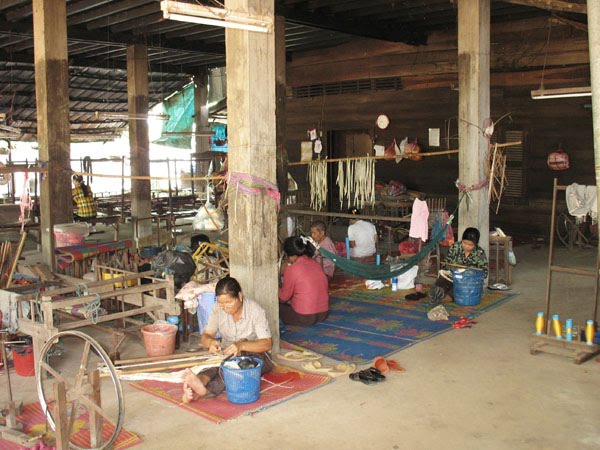
IKTT - The Rest of the Story
After visiting IKTT in Siem Reap, I was invited to join Mr. Morimoto Kikuo the next day at his other site, 'Wisdom of the Forest'. Located 30+km outside of Siem Reap, it is the incubator for the raw materials used in the production of IKTT's textiles. Here, on a large plot of land out in the country, he oversees the care and feeding of the silk worms, complete with an orchard of mulberry trees; there is an indigo plantation; other dyestuffs are grown; cotton is grown and processed; and the banana fibers necessary for tying the threads prior to patterning are prepared. Numerous workers and their families live on site, and there is a guesthouse for visitors; interested parties can stay for days, or weeks to observe and receive firsthand experience in the different stages of the processes. Mr. Morimoto has a home here and I was fortunate that he had time to show me some of his personal textile collection, which included some beautiful antique 'hol', as well as some of the tribal cotton textiles from northeast Cambodia.
 Mr. Morimoto Kikuo shows a cache of silk cocoons awaiting processing.


 (Above) Banana tree trunks are cut and then sliced into strips to make the fibers for tying the threads for patterning (below), prior to dyeing. Most ikat-makers now use plastic fibers for this step, but IKTT finds that the banana fiber produces better quality designs.


On the drive out to IKTT's country site I noticed the use of scarecrow-like figures propped up at the entries of most of the properties along the road. This is something we do not see in Thailand. I subsequently read that they are usually put there after misfortune has struck- illness, accident, whatever- to scare away malevolent spirits believed to have caused the problem. Sadly, they were fairly ubiquitous on our journey.
The journey was not without our own discomforts: recent rains had left the red dirt roads pocked with holes and deep ruts, making the ride very rough. Cambodian 'tuk tuks' are not like Thai 'tuk tuks': they are glorified horse buggies hitched to, and powered by small motorcycles which the driver rides. I couldn't help but compare the journey to those made in pre-auto times with horse-drawn coaches as the mode of conveyance. Thankfully, Mr. Ral, my faithful driver was prepared, as he stopped and whipped out a much-welcome pillow for my back. Needless to say, I was very thankful when it was over and we were back on paved roads.
 Mr. Morimoto Kikuo shows a cache of silk cocoons awaiting processing.
Here they are boiled to dissolve the sticky substance which holds the fibers together,
and allows for the winding of the filament onto a special reel (below)
and allows for the winding of the filament onto a special reel (below)

 (Above) Banana tree trunks are cut and then sliced into strips to make the fibers for tying the threads for patterning (below), prior to dyeing. Most ikat-makers now use plastic fibers for this step, but IKTT finds that the banana fiber produces better quality designs.

These ladies are processing 'stick lac' in a mortar so that it can be used to make the dye
for the beautiful red color used on silk in this part of the world. 'Stick lac' is
a resinous deposit made by insects onto tree branches.
for the beautiful red color used on silk in this part of the world. 'Stick lac' is
a resinous deposit made by insects onto tree branches.

On the drive out to IKTT's country site I noticed the use of scarecrow-like figures propped up at the entries of most of the properties along the road. This is something we do not see in Thailand. I subsequently read that they are usually put there after misfortune has struck- illness, accident, whatever- to scare away malevolent spirits believed to have caused the problem. Sadly, they were fairly ubiquitous on our journey.
The journey was not without our own discomforts: recent rains had left the red dirt roads pocked with holes and deep ruts, making the ride very rough. Cambodian 'tuk tuks' are not like Thai 'tuk tuks': they are glorified horse buggies hitched to, and powered by small motorcycles which the driver rides. I couldn't help but compare the journey to those made in pre-auto times with horse-drawn coaches as the mode of conveyance. Thankfully, Mr. Ral, my faithful driver was prepared, as he stopped and whipped out a much-welcome pillow for my back. Needless to say, I was very thankful when it was over and we were back on paved roads.
Labels: cambodia, hol, ikat, IKTT, indigo, Khmer silk, Morimoto Kikuo, mulberry, natural dyes, scarecrows, Siem Reap, silk, stick lac, textiles, tribal textiles, Wisdom of the Forest
posted by Tribal Trappings.com at 4:12 PM